Showing posts with label science fiction. Show all posts

Friday, March 24, 2017

Ninth City Burning by J. Patrick Black


Ninth City Burning takes place around 500 years into the future where humanity is embroiled in a centuries long war with an alien race. When the aliens, or Romeos as they are called in the story, first came, they brought an unstoppable, reality altering power called thelemity. It seemed all was lost until humanity realized that some of their own could also wield this same power. Ever since their first onslaught was beat back, much of the technology has been related around thelemety and fighting the Romeos. However, after centuries of attrition, the Romeos have changed tactics and it could mean the end of Earth. 

The story is told from the point of view of 7 characters and each of these is narrated by a different actor in the audio version. We follow each of these seven, all from different background and vastly different perspectives on the conflict as they start to come together and try to save humanity. 

Overall, the story can be a bit formulaic and there are segments where you know exactly what is going to happen next. But the the multiple narrators and characters do keep it interesting. I hope that in the next book, Black manages to keep plot points better concealed and less trope-ish. A good listen overall and recommended for fans of coming-of-age sf/f such as Ender's Game and Hunger Games. 

Friday, February 24, 2017

The Expanse Book & TV Series


It seems like just about everything coming out on TV or in the theater is either a remake or based upon a book.  TV shows especially seem to be well suited to this as we have seen with Outlander, Game of Thrones, The Walking Dead, and others. Today, in particular, I’d like to look at a TV series that might have gone unnoticed by a lot of people, The Expanse. It is a very good series with the same name written by James A. Corey.  Currently, there are 6 books published and 3 more in the works. The first season covers approximately the first half of the book so there is room for plenty of seasons depending on how the writers pace things and use the original material.

 The Expanse is a sci-fi thriller set in the not-too-distant future where humanity has colonized the solar system. Earth is united, Mars is its own political entity, and both are struggling to keep the nascent power of the outer planets and satellites, aka the belters, from becoming independent. A reluctant but caring ship captain and a broken down belter detective get involved in a missing persons case which uncovers an amazing discovery that threatens the entire solar system.   

The adaptation is one of the best that I have seen. The majority of the characters are exceptionally well cast and there are only minor alterations to the story. Even better, the zero-g and low-g effects are amazingly well done. With only two seasons out, we might be in for a long haul before the series, both TV and book, are done. But trust me, this is a story that is well worth it, whether you watch or read.


Saturday, July 30, 2016

Awesome Audios!

To round out the month of July and our focus on everything audio, I present two of my favorite audiobooks. Personally, I am not an audiobook person. I appreciate the audiophiles who have such an intense love and knowledge of all things audiobook, but I seem to have a very fraught relationship with them. However, everyone once in a while, I come across one that grabs me.

Ready Player One by Ernest Cline
First of all, you have to read this book. Whatever format you prefer, just read this book. I highly recommend the audio version because you get the delight of a good story paired with the vocal stylings of Wil Wheaton. Actually, if you love audiobooks or Wil Wheaton, I recommend any book he narrates.
The story is set in 2044 when the Earth has been ravaged by famine, poverty, and disease. All the people who struggle with a day-to-day existence escape to the OASIS, a virtual world lacking all of the misery in the real world. The creator of the OASIS has hidden puzzles that will lead to a massive fortune, but no one has been able to unlock one until Wade comes along. From there, the story turns into a fantastic, action packed adventure into 80s nostalgia.

Between the World and Me by Ta-Nehisi Coates
Authors are not necessarily the best choice as narrator for audiobooks. However, memoirs and other personal nonfiction seem to be the most logical books to be read by the author. Personal accounts of sensitive topics or life altering events can sometimes only best be read by those who lived them.  Ta-Nehisi Coates’s book, Between the World and Me, is one of these books.
Coates’s poignant memoir framed as a letter to his teenage son is a must read. It discusses the impact of American history and ideals on the safety and perception of black Americans. It is Coates’s personal history and his awakening to the truth about his place in the world, which is best told in the author’s voice rather than by a disconnected narrator. 

Tuesday, May 24, 2016

Private Eye by Brian K Vaughn


As the name might imply, Private Eye by Brian K Vaughn is at its heart and detective story. In fact, it is a fairly classic one. A mysterious lady steps into the P.I’s office with a job. After some reluctance, he agrees to start on it in the morning. Once the client returns home, she is murdered by a familiar face. The client’s sister assumes the P.I. did the deed and confronts him only to end up employing his services to hunt down the murderer. The investigation leads to stealing information, car chases, blackmail, bribery, gun battles, and a large conspiracy. A fairly straightforward and oft used tale, where it gets interesting
is the setting. Vaughn places the whole story in a future where the cloud burst and everyone’s online secrets were spilled. Now, there is no internet and everyone has a secret identity. When people go outside, go shopping, interact, even when they answer their own door, they don masks and fake names.

Vaughn does an excellent idea meshing together the old detective trope with the sci-fi future. In doing so, he keeps the story fresh and speculates on a future obsessed with real world privacy. Martin and Vicente do excellent work with the art and colors, creating compelling and dynamic visuals, richly portraying this weird future but without seeming too busy as Ellis’ Transmetropolitan does at times.

If you like Vaughn’s other work (Saga, Paper Girls, Ex Machina), enjoy a good pulp mystery with a dose of sci-fi like Caves of Steel, or just want to pick up a good Graphic novel, then I would recommend Private Eye.


Thursday, March 24, 2016

ApocalyptiGirl: An Aria for the End of Times by Andrew MacLean

ApocalyptiGirl: An Aria for the End of Times by Andrew MacLean

At its core, ApocalyptiGirl is a simple post-apocalyptic story about a girl and her cat, Jelly Beans, trying to survive the world. Two tribes war over resources, the Blue Stripes and the Grey Beards. We also learn that she is on a mission, hunting and ancient power source for the past five years. Her search accelerates and puts her and Jelly Beans on a dangerous path after a confrontation with a young Blue Stripe savage.

Weighing in at 96 pages, this is a very quick little graphic novel that does not leave a lot of time for messing about. While it would be nice to see certain aspects, such as world building and background developed, this is essentially a novella and, as such, does not really have the time to spare. Within those relatively few pages, MacLean does an excellent job with pacing the story and delivers some excellent artwork that does an excellent job supporting the story.

In all, ApocalytiGirl is an interesting take on the whole post-apocalyptic genre, playing some with the well-worn trope. MacLean also brings some excellent visuals to his story making ApocalyptiGirl an interesting, if brief read.


Tuesday, September 29, 2015

Wesley Chu's Time Salvager

Time travel, like evil mustache mirror universes and megalomaniac robots, is a pretty common thing in science fiction. In pretty much a sci-fi franchise, they will eventually get around to a time travel episode. Cliché as it can be, a well done time-travel story can have some very interesting and powerful points in terms of history, culture, and societal perceptions. Wesley Chu's Time Salvager touches on all these factors and tells an excellent story.

Set in the resource strapped 26th century, we follow James Griffin-Mars, highly trained ChronoCom operative that is quickly approaching the projected life expectancy in his field, time travel. The future James is in has slowly been collapsing, Earth is polluted beyond recognition, they have forgotten many technological advances and while humanity has colonized many planets and stars in the solar system, they are constantly low on resources.  James is sent back in time to moments before disasters to retrieve resources; metals, technology, food, even trees. Yet, since his missions occur right before disasters, James is constantly witnessing people die and the justifications that they were already doomed are wearing thin on James’ stressed mind. Finally, on a very high-profile mission, James snaps and breaks the first law of ChronoCom and brings back Elise, a scientist from the 21st century. Now, he has is on the run from both ChronoCom and the corporation that bankrolled his mission.


Time Salvager takes a little on the set up and the very obvious set up for a sequel are slightly frustrating. But Chu’s vision of a declined humanity and pollution choked earth hits close to home. He also does a wonderful job with his main characters. James is highly skilled at what he does but is also a convicted criminal and a very flawed character with impulse control, a drinking problem, and exceptionally fuzzy ethics. But he acts as a wonderful foil to the unrelenting optimism of Elise and Chu does an amazing job of telling both sides of the story from each characters perspective. I will admit that I was annoyed to end the book with the realization I would have to wait until a sequel to completely resolve all plot points, I am certainly going to grab that sequel as soon as it comes out. 

On a side note: the cover design and artwork for Time Salvager is simply excellent and does a wonderful job of capturing the feel of the novel.

Tuesday, July 7, 2015

The Left Hand of Darkness by Ursula K. Le Guin

Somewhat recently, I was asked to consider what some of my all-time top novels would be. This is always a difficult proposal as are you looking for entertaining, for thoughtful, for a specific genre? After some deliberation, I went with one of my all-time favorite science fiction novels, The Left Hand of Darkness by Ursula K. Le Guin.

It is the story of a human emissary on a lone mission to include the world of Gethen, a frozen, winter world into the growing galactic civilization. The Envoy, Genry Ai, must contend with distrust, fractious politics, and entrenched religions. But the denizens of Gethen are also incredibly odd in their familiarity. They are asexual, and can and do choose their gender. It is conceivable that one Gethenians could have both sired and given birth to children. Genry must separate his gender identity assumptions from his dealings with the Gethenians.

The story also follows Estraven, a Gethenian and prime minister to the Kingdom of Karhide. Estraven gives us the best look into the culture of Gethen through a slowly, but wonderfully revealed backstory. Also, he provides a fascinating look into Le Guin’s conception of a society where gender identity is equal parts fluid and non-existent


On the surface, the book appears to be a thought experiment regarding gender assumptions. In fact, many reviews and analysis of the work focus on this. Yet, as with any good novel, there is so much more to the tale. Le Guin puts forth some fascinating and thought provoking ideas about philosophy, religion, relationships, and much more. The many, compelling layers of this book make it an excellent read and are one for the reasons I occasionally go back to Left Hand of Darkness and reread chapters. In all, I highly recommend giving this book a read.  

Wednesday, February 25, 2015

Steampunk: a Blend of Action, Adventure, Science, and Magic

Steampunk is a type of science fiction/fantasy that often mixes the modern with the antique.  It originated in the 1980s and blends together a number of sub-genres such as: science fiction, fantasy, mystery, alternative history, and horror.  It's settings are usually Victorian-era Britain although some are set in the American Wild West or even a post-apocalyptic future.

While clockwork and steam-powered contraptions are a common steampunk theme, there may be others such as:  the pairing of hard science with magic or futuristic technology with mechanical machines.

So, try some of the following steampunk books--you'll be happy you checked them out.

Poison Fruit by Jacqueline Carey

The paranormal town of Pemkowet is led by Daisy Johanssen, agent of Hel.   But as a nightmarish monster racks up victims, someone else files a lawsuit against the town. If Pemkowet loses, the fate of the community will be at stake. 

The Shotgun Arcana by R. S. Belcher

Golgotha, Nevada. 1870. A haven for all including a fallen angel, a mad scientist, a pirate queen, and a deputy who is kin to coyotes, Golgotha has come through many trials, but now an army of killers is converging on the town, and its people will be tested as never before.


Gideon Smith & the Brass Dragon by David Barnett

Nineteenth century London is where Queen Victoria presides over three quarters of the known world.  The pirate Louis Cockayne has stolen a fantastical weapon-a great brass dragon. Gideon and his intrepid band give chase through the lawless lands of free Texas where life is cheap and honor cheaper. 

The Clockwork Dagger by Beth Cato

Octavia, a young healer with incredible powers, is traveling to her first mission. Suddenly, she is caught up in a flurry of intrigue:  the steward may be one of the infamous Clockwork Daggers! The danger is only beginning and the conspiracy may reach to the crown itself.

The Return of the Discontinued Man by Mark Hodder

In 1860 London, a scientist conjures up Spring Heeled Jack, who is hunting Sir Richard Burton! Meanwhile, Burton is experiencing visions and now he must voyage through time into a twisted future ruled by a cruel intelligence.
  
The Executioner’s Heart by George Mann


Chief Inspector Bainbridge of Scotland Yard is called to a third, symbolic murder. Supernatural specialists Newbury and Hobbes conclude that the killings may be the work of the Executioner. Who will be her next target? 

Cold Copper by Devon Monk

In steam age America, lycanthrope Cedar Hunt and witch Mae Lindson set out on a mission. Taking refuge in Des Moines when a storm hits, they must stop the mayor’s plot to rule the world.

Fiddlehead by Cherie Priest

Ex-slave Gideon Bardsley is a brilliant inventor. To keep Gideon safe, Abraham Lincoln calls on Pinkerton "Belle" Boyd.  Can she keep the greedy warmongers from assassinating Gideon and extending the Civil War? 
  
The Ripper Affair by Lilith Saintcrow


An accident places Archibald Clare, a mentath in the service of Britannia, in the care of sorceress Emma Bannon. He needs rest to repair his abilities, but someone is murdering women of a certain reputation and threatens to bring ruin to the Empire. 


Also, try some of these stand-alone novels and series number ones:

Balfour and Meriwether in the Incident of the Harrowmoor Dogs by Daniel Abraham
The Windup Girl by Paolo Bacigalupi
Phoenix Rising by Pip Ballantine and Tee Morris
Doktor Glass by Thomas Brennan
Soulless by Gail Carriger
Half Made World by Felix Gilman
Mainspring by Jay Lake
God Save the Queen by Kate Locke
The Buntline Special by Michael (Mike) Resnick
Leviathan by Scott Westerfeld
Retribution Falls by Chris Wooding


Tuesday, October 28, 2014

The Martian by Andrew Weir

The Martian by Andrew Weir is amazing in that it is fiction that it has an impressive amount of solid science woven into the story. Apparently, Weir did a fair amount of research to make sure that he had the fact right, only disregarding the facts at one point for the narrative. The story itself is a classic man versus nature survival tale, just taking place on a completely different planet. Astronaut Mark Watney, mechanical engineer and botanist for the Ares 3 expedition to Mars, find himself in a precarious position. His crew had to abandon their habitat and leave him behind in a terrible storm that holed mark’s suit a storm and swept him Mark away. Now, Mark has no way to communicate with Earth, he has to figure out how to make a few months worth of food last a few years, how to keep the Hab running, how to travel a few hundred kilometers in a rover designed for a tiny fraction of that, and, worst of all, how to survive on the disco and old sit-coms that are the only entertainment on hand.

Comparisons have been made with Apollo 13 and Castaway (apparently Tom Hanks would be a killer Mark Watney). Being the more literary type, I mentally compared it to the survival elements seen in Hatchet by Gary Paulsen and Robinson Crusoe by Daniel Defoe and the scientifically accurate adventure seen in Jules Verne’s 20,000 Leagues Under the Sea. Frequently, science fiction reads just like fantasy, just with lasers and spaceships instead of magic and dragons.  Really good science fiction is a gem, but it’s even better when you find a science fiction novel that is so heavy on the science part.


It might be worth noting that apparently, The Martian has already been optioned out for movie production with Matt Damon, not Tom Hanks, cast as Mark Watney and with Ridley Scott directing. 

Tuesday, October 21, 2014

The Sirens of Titan by Kurt Vonnegut

The Sirens of Titan by Kurt Vonnegut

In the classic manner of Vonnegut, Sirens, defies genre labels and is inherently difficult to describe. There is science fiction, there is morality, there is religion, there is war, and there is love and loss. But I am not sure that Sirens could be called a novel of any of these (although it was nominated for a Hugo in 1960).  The primary characters are Winston Niles Rumford and Malachi Constant. Rumford, an intrepid man that got stuck in a chrono-synclastic infundibulum. This means he appears, at regular intervals, on Earth and other planets dispensing prophetic proclamations while accompanied by his dog, Kazak. Constant is incredibly rich and sybaritic, but suffers a number of interesting turns. Malachi is told by Rumford that he will have a son with Beatrice, travel from Earth to mars to mercury and to Earth again before finally ending up on Titan, a moon of Saturn. The subsequent plot defies summary nearly as well as Sirens defies categorization. But each step of Malachi’s journey is filled with that odd, poignant mixture of humor and tragedy that Vonnegut can do so well.


An aside note: I picked up this title for two reasons. First, both Vonnegut and Sirens are frequently mentioned in The UniverseVersus Alex Woods by Gavin Extence, the book for October’s meeting of Uncorked. Second, I was making a weekend trip to Indianapolis, Vonnegut’s hometown, and was planning on stopping by the Vonnegut Memorial Library. In the midst of prowling the streets of Indianapolis for some pizza, I came across this huge portrait of Vonnegut by Pamela Bliss it was pleasant and unexpected. Anyway, I can recommend pretty much everything mentioned in the previous two sentences in addition to Sirens

Tuesday, August 19, 2014

Hugo Awards Announced

This weekend, at LonCon 2014, the Hugo Awards were announced and there are some excellent, excellent winners and I believe that much of the SF community is coming away with some good feelings about the whole thing. 

For me specifically, one of the most interesting aspects of this year’s awards was the short list for the best novel, specifically the debut Ancillary Justice by Ann Leckie and the massive Wheel of Time Series by Robert Jordan '(with the help of Brandon Sanderson for the final 3 novels). As best as I can tell, these were the two leading titles and people would have only been surprised if neither of them won. Despite both being favorites, there are some decidedly noteworthy differences. While AJ has been sweeping the awards this year, snagging a Nebula, an Arthur C Clarke award, and the British Science Fiction Association, the WoT series has been around since 1990, was only recently finished and weighing in at 3.5 million words, does a good job of defining epic fantasy. 
In fact, some would argue that it is, the very dentition epic fantasy and very likely trots out just about every trope of the genre at least once. Don't get me wrong, the books are still good and have a strong enough following that the series even has its own Convention. In fact, there was some worry in the community that there would be a glut of voters signing up solely to vote for the WoT series and would disregard the other categories (analysis shows that this didn't happen). Finally, Sanderson had to be brought in to finish the series. A feat that is difficult to manage and that he pulled off wonderfully. 

Conversely, Leckie's debut gives a unique perspective of a revenge tale mixed with an excellent exploration of self and gender. In my opinion, there are two things that make AJ simply excellent. First, you get thrown right into the deep end. There is no winding road to learn about the protagonist and their toils and tribulations. In fact, the first few chapters make for some mental chewing and revisiting just to stay afloat. Then, when you start to feel you have a handle on things and you think you are getting the hang of the depths, Leckie starts hurling waves at you. Second, the protagonist has difficulty telling gender and defaults to "she" and "her". It might not seem like much, but to have all of the characters resist even this level of categorization drastically changes how the entire story is read.

In realizing that this post is in danger of rambling on eve more, I will end with this, go out and read both of these stories, they are both excellent for some very diverse reasons. 

Tuesday, July 22, 2014

Federal Bureau of Physics

Graphic novels are a fascinating medium when they go beyond superhero vs supervillan (though there are some excellent storylines of this type). In addition to all the usual literary elements of plot, character development and so on, you have the added difficulty of visual elements, line, color, perspective, etc. To me, FBP, written by Simon Oliver and inked by Robbi Rodriguez and Nathan Fox, does a wonderfully entertaining job blending these two mediums in such a way that each supports and emphasizes the other.

We are all used to hearing about disasters and even living through them, from smaller such as localized flooding to bigger such as hurricanes. We are even familiar with federal agencies that deal with such events. But what if the disasters took a completely different form, say of the quantum variety? Enter the Federal Bureau of Physics and one Adam Hardy. The FBP gets called in on localized gravity failures, time dilations, quantum tornadoes, and bubbleverses in a world where the rules of physics are bending and breaking before our very eyes.  Special Agent Hardy is in on the front lines of these localized breakdowns, but has considerably larger issues than welding shut a gravity rift. The FBP is being pressured with threats of privatization, an old partner with an alternative agenda, a new partner that is standoffish and mysterious, and a conspiracy that started with his father, one of the founders in the field and one of the first casualties to it.

The artwork is bold and excellent, making use of a wild array of colors and styles that emphasize the chaos in a world where physics can just cease to work. Small details of the characters seem to vary more than conditions allow and the perspective angles seem designed to upset any sense of up and down.  


In all, this was a brilliant story, starting off with a classic conspiracy and ending with a classic bank heist, each with done with the panache possible in a universe where the laws of nature can take breaks. Fans of Chew, Hinterkind, East of West, and Saga should definitely enjoy this story. Be warned, this is only the first in the series and the others have yet to be published, so you may have to wait to see what happens Agent Hardy and the FBP after vol 1.

Tuesday, April 1, 2014

Angelic Noir


Something More than Night by Ian Tregillis

The story opens up with the death of the Archangel Gabriel, a cynical angel gone native, and the recently deceased Molly, who has been tapped to take the place of Gabriel. It is the story of a murder mystery, of a long con, of an angelic choir, all with enough deceit and misdirection, grit and smoke, to make any Philip Marlowe fan happy.


The story opens with Bayliss, an angel that has been “slumming with the monkeys” down on earth that has been tapped by an unnamed power in heaven to find a replacement for the recently killed Gabriel. For this, he needs someone freshly dead and sets his eyes on a simple pushover. Instead of getting his intended patsy, he offs the spunky sister, Molly. Now the pair have to figure out why Gabriel was murdered, where the powerful Jericho Trumpet is, and figure out what shadowy movers are behind it all.

The 40’s-style slang can be a bit much at times, confusing the dialogue, but is an affectation lends realism to Bayliss and is an entertaining juxtaposition to some of the other angels. Molly’s frantic, bumbling attitude can be a bit tiresome, but eventually her spunky attitude starts to some around for the better. The story has plenty of slow moment, heavy with dialogue but rich with details that paint an excellent noir story.  In all, Tregillis, does an excellent job of blending noir, Augustinian heaven, urban fantasy, and a dash of metaphysics.

Tuesday, March 18, 2014

Post-Apocalyptic Superheroes With A Side Of The Undead

Ex-Heroes by Peter Clines
 
Over the past few years, we have seen a preponderance of both zombie and superhero related books and movies. Individually, they have both been done so heavily that some people, myself included, have an instinctual eye-roll, when hearing of a new film or title dealing with either the undead or some caped crusader  (admittedly, the eye roll is followed by grabbing it to see it its any good because let’s face it, both can be pretty entertaining).  When I spotted Ex-Heroes it was no different. Yet, Clines brings both the undead and superheroes together in a decidedly entertaining way. First, our superheroes are holed up in the now fortified Paramount studios lots. Second, the handful of heroes is attempting to rebuild some semblance of civilization with a few thousand normal survivors. There is also a competition amongst the normal guards to see who can put down the greatest number of celebrity zombies.
 
Cline brings us into the story about 2 years after the initial outbreak. The Mount, where everyone is holed up, is a mostly functioning society with the heroes acting as guardians and, to a degree, the government. Yet, they start to learn that scrounging for supplies and avoiding the undead is not the only things they have to worry about. An L.A. street gang seems to be growing in strength and growing in power. But the oddest thing is that the gang seems to somehow have control over the zombies, including a few superheroes turned zombies.
 
                There is very little surprising in Ex-Heroes, but Clines does an excellent job about breaking up the main plot with a mixture of the heroes’ backstory and the events leading up to the apocalypse. Additionally, he does a solid job giving each of the heroes dimension and character.  It certainly is not a story to tickle your intellect, but certainly an amusing caper for a few afternoons.


Tuesday, February 18, 2014

80's Nostalgia and Cyberpunk

Ready Player One by Ernest Cline

Simply put, Ready Player One is a cyber punk, no holds barred, adrenalin- fueled nostalgia ride of the 1980’s. It follows Wade Watts, with the gamer tag of Parzival, in the near future as he goes to school, scrounges for power, and practically lives in OASIS, a huge virtual world. Most of Wade’s time is spent his quest to solve the riddle, the golden ticket of his generation. A series of clues and journeys created by James Halliday, the inventor of OASIS, which will give the winner a massive fortune and the keys to the kingdom, control of the entire OASIS network. Halliday was obsessed with 80’s culture, so every hint and puzzle are intrinsically tied into the arcade games, TV shows, movies, and music of the 1980’s.

Admittedly, large chunks of the effort on scene development and descriptions seem to largely be aimed at dropping as many references to 80’s sci-fi, pop culture, and video games as physically possible. While this can sometimes get a bit out of hand, Cline does provide some interesting social commentary with his descriptions of the OASIS system, specifically how many people are using it as an escape from the world, almost to the point of being a drug addiction. Cline also presents an interesting take on free speech versus advertising as a motivation for a number of players in Halliday’s quest.

While Ready Player One does not dig overly deeply into many issues present in cyberpunk, he certainly manages exhibit them in an entertaining, albeit heavily fan-serviced, manner. You do not need to be incredibly well versed in the 80’s to enjoy this book. Cline makes so many references, that you are bound to come across one that you like.

Tuesday, October 15, 2013

William Shakespeare's Star Wars: Verily, A New Hope by Ian Doescher

William Shakespeare's Star Wars: Verily, A New Hope by Ian Doescher

Being a self-admitted sci-fi nerd, bookish, and a librarian causes me to stumble across some very interesting and unique crossovers, parodies, and mashups. Most people are familiar with Pride and Prejudice and Zombies and its other similar spin offs. I have also come across a slightly more puzzling crossover in the form of a graphic novel of Dr. Who teaming up with Cpt. Jean Luke Picard to stop a Borg/Cybermen alliance. But what has most recently caught my attention is Williams Shakespeare's Star Wars: Verily, A New Hope by Ian Doescher. Now, initially I was torn between excitement and annoyance regarding this combination of two things I very much like and never thought to combine. However, Ian Doescher, did a spectacular job transferring Star Wars: A New Hope into the language and the style of the Bard himself. He stays true to much of the plot and even works in some more well-known lines from the movie. Doescher does add a few bits that you don’t find in the movie, such as Luke Skywalker’s “Alas poor, Stormtrooper” scene, a clever take on the “Alas, poor Yorick” done in Hamlet.    

Yet, there are a few downsides to this book. You might get odd looks from coworkers and family as you regale them with the St. Crispin’s Day from Henry V pastiche that occurs before the Death Star trench run. Also, was with most Shakespeare, it really does work best if read aloud. So, if you can find friends and relations that would enjoy this nerdy mix-up, I would highly recommend getting them together and giving this book a try.

Tuesday, October 1, 2013

Saga, Volumes 1 & 2 by Brian K. Vaughan & Fiona Staples


Saga, Volumes 1 & 2 by Brian K. Vaughan & Fiona Staples
Graphic novels, by their nature and history, have a tendency to play with themes and concepts that are a bit odd even in science fiction novels. The story starts in the middle of a long, ongoing war between two races, one uses magic and the other technology. The conflict has gone on for so long that the two species have opted to outsource their battles to other planets in order to save their own from the devastation of war. Our main characters are star-crossed lovers, one from each of the feuding species. We come into the story as their child is being born and they learn that both of their species is hunting them and their child to put an end to all three.
The storytelling is remarkable; we learn small bits of the backstory and the unique universe that Vaughan has created. With little fragments, he brings a story of war and love, of life and cultures, machines and nature, so complex, so strange that even the participants of the story are never sure what to expect.
This graphic novel is not for everyone. There are liberal amounts of sex, nudity, violence, gore, language, and general weirdness. , But if such things do not bother you, then I would strongly recommend you read these graphic novels and experience for yourself. For every crass moment that Vaughan writes and Staples draws, there are equally poignant moments and it becomes clear how Saga won the Eisner Best New, Best Continuing, and Best Writer Awards for 2013.

Tuesday, August 20, 2013

Book Cover Art


Science fiction, in my opinion, is one of those genres that lends itself exceptionally well to art. Admittedly, some of the art that is produced for the genre is incredibly cliché, with ray guns, aliens, and spaceships garishly splashed across the cover. I have noticed that frequently, there seem numerous instances where the art does not seem to match what is inside the book.

But numerous, talented artists have made the amazing worlds come to life. An excellent and recent example is the episodic Human Division by John Scalzi, where every episode’s cover was painted by John Harris. On all 13 covers, the title and author dominate, but in the middle is a small yetexcellent example of sci-fi cover art. Each is done with a subdued palette and the minimalist subject matter relates beautifully to the story within.


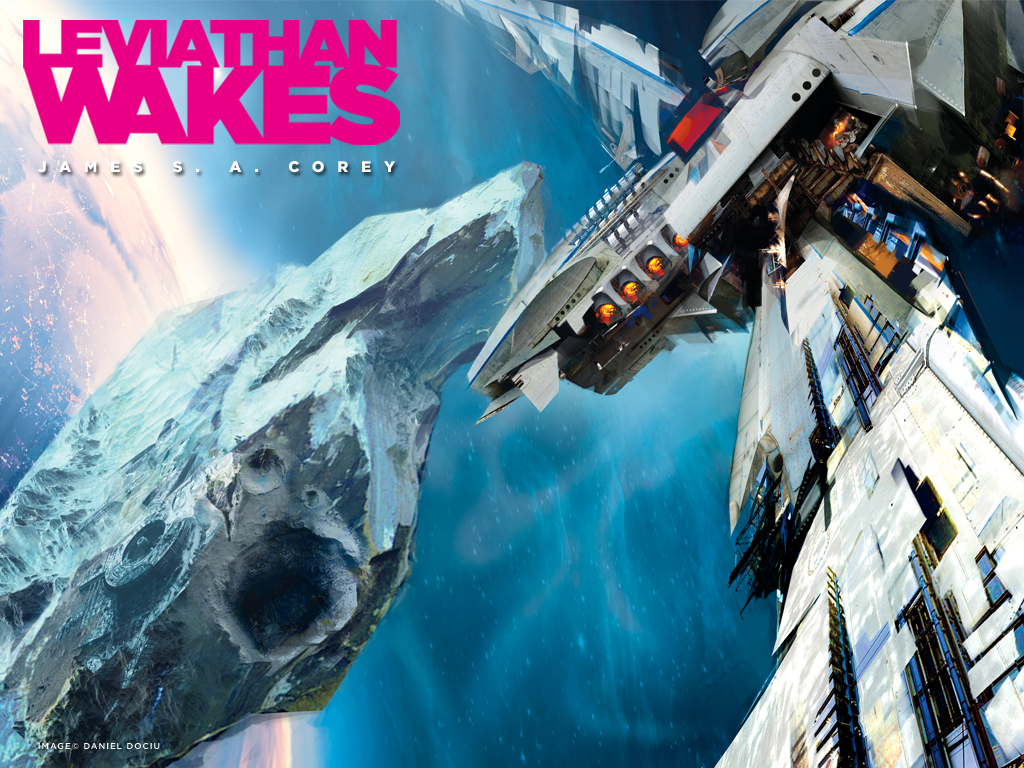
There is also the cover for Leviathan Wakes, by James S.A. Corey. The artist, Daniel Dociu, makes excellent use of foreshortening, perspective, and scale to create a dynamic cover that truly works with the book.


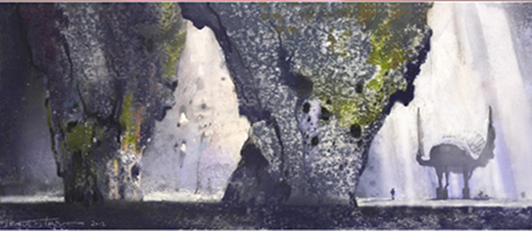
What prompted this post is that I recently stumbled across this article from the rebooted Omni magazine (Omni was a sci-fi magazine that ran from 1978-1998 and is currently undergoing an online revival) that reveals some of the original art done by JohnSchoenherr for Frank Herbert’s 1965 Dune. While Dune may not have the cult following of Lord of the Rings or Star Wars, is it just as compelling and influential. The most notable attempts to visually capture Dune are by Peter Lynch (1984) and Syfy (2000), each with mixed reviews. But, the work by Schoenherr captures what I envisioned the planet to be when I first read it years ago. Apparently, I am not the only one to think that as Herbert himself praised Schoenherr for the accuracy of his work. Stylistically, the works are obviously dated to the 60’s, but that does not detract from the simple elegance with which he portrays Dune and the characters therein.

Wednesday, July 31, 2013

Hunger Games Read-alikes Part 2--Good Teen Reads!

About a week ago, I wrote a blog about adult titles that are similar to The Hunger Games and other post-apocalyptic books.  The response was fantastic, so I didn't want to miss this chance to introduce you to some wonderful teen titles as well.

Drought by Pam Bachorz
Ruby dreams of escaping the Congregation, but without her blood her community is condemned to certain death.

Ashes by Ilsa J. Bick
Three teens join forces after an electromagnetic pulse kills most of the world's population, turning some of the survivors into zombies.

Taken by Erin Bowman
In the mysterious town of Claysoot, every male is mysteriously "Heisted" on his eighteenth birthday. 17-year-old Gray Weatherby is determined to find out why.

The Testing by Joelle Charbonneau
16-year-old Cia Vale is chosen to participate in The Testing to attend the University. However, she is fearful when she discovers that those who failed--are disappearing.

Little Brother by Cory Doctorow
After being interrogated for days after a major terrorist attack, Marcus uses his computer hacking skills to set things right.

Among the Hidden by Margaret Peterson Haddix
In a future where the Population Police limit families to only two children, Luke has lived all of his twelve years in hiding and isolation.

The Line by Teri Hall
The Line is an invisible border of the United States.  When Rachel has an opportunity to Cross into the forbidden zone, she is both frightened and intrigued.

The Eleventh Plague by Jeff Hirsch
15-year-old Stephen, his father, and grandfather scavenge in post-Collapse America.  When tragedy strikes, Stephen's life is turned upside down.

The Unidentified by Rae Mariz
In a futuristic alternative school, Katey "Kid" Dade struggles to figure out where she fits in or even if she wants to.

Delirium by Lauren Oliver
Lena looks forward to receiving the cure that prevents the delirium of love. Then ninety-five days before treatment she falls in love.

Life As We Knew It by Susan Beth Pfeffer
In her journal, 16-year-old Miranda describes her family's struggle to survive after a meteor hits the moon.

Variant by Robison Wells
After years in foster homes, 17-year-old Benson Fisher applies to Maxfield Academy in hopes of securing a brighter future.  What he discovers is that the school is a prison and no one is who they seem.

Uglies by Scott Westerfeld
Tally is about to turn 16 and get the operation that makes her "pretty".  Her friend Shay doesn't want the operation and runs away. And Tally learns a whole new side of the pretty world--and it isn't very pretty.

Some staff favorites:

The Maze Runner by James Dashner
16-year-old Thomas wakes with no memory and in the middle of a maze. How will he escape?

Gone by Michael Grant
In a small town, everyone over the age of fourteen suddenly disappears, setting up a battle between the remaining groups of young people.

Legend by Marie Lu
In a dark future where North America has split into two warring nations, two 15-year-olds--one a famous criminal and the other a prodigy soldier, discover they have a common enemy.

Under the Never Sky by Veronica Rossi
"In a world of danger, an unlikely alliance."  "Outsider" Perry rescues Pod-dweller Aria in this dystopian tale about an ecological collapse.

Divergent by Veronica Roth
In a future Chicago, 16-year-old Beatrice must choose one of five factions to define her identity. A choice made more difficult when she discovers she doesn't fit into any one group.


The 5th Wave by Richard Yancey
Cassie Sullivan, the survivor of an alien invasion, must rescue her young brother with the help of a boy who may be one of "them".

Blood Red Road by Moira Young
Saba and her family scavenge the dried up wastelands of Silverlake.  When her twin Lugh is kidnapped, Saba embarks on a dangerous quest to get him back.


What is your favorite?  Let me know if you can add any to the list.


Wednesday, July 17, 2013

Hunger Games Read-Alikes and Other Post-Apocalyptic Sci-Fi

If you have already read the Hunger Games trilogy multiple times, eagerly watched the movie, and can't wait until November for Catching Fire to be in theaters then here are some good reads to tide you over:

The Year of the Flood by Margaret Atwood
A religious leader has long predicted an Earth altering disaster.  Now it has occurred.

The Windup Girl by Paolo Bacigalupi
Bangkok is struggling for survival in an era of rising sea levels and mutations run amok.

Jennifer Government by Max Barry
In a future where people take the names of companies, Hack Nike tries to get out of a deadly contract.

Armageddon's Children by Terry Brooks
In a futuristic world, evil controls the ruins of the United States and one man must search for a child that could save the world. A trilogy.

Parable of the Sower by Octavia E. Butler
In 2025, after her neighborhood is destroyed, a young woman named Lauren begins a journey.  Sequel is Parable of the Talents.

Player One: What is to Become of Us by Douglas Coupland
During a global disaster, an airport cocktail lounge becomes a refuge for five total strangers.

Never Let Me Go by Kazuo Ishiguro
A hopeful science experiment exacts a terrible price in this moving story of love and friendship.

The Children of Men by P. D. James
In 2021 humans are infertile and a historian and an unlikely band of rebels may hold the key to survival.

When She Woke by Hillary Jordan
The story of a stigmatized woman struggling to navigate an America of a not-too-distant future.

The Long Walk by Stephen King
In a futuristic America, 100 boys must endure a 500 mile, lethal race in order to win fame and fortune.

1Q84 by Haruki Murakami
A love story, a mystery, a fantasy, and a psychologically charged tale that draws on Orwellian themes.

Blindness by Jose Saramago
A city is hit by an epidemic of "white blindness" and the victims are confined to a vacant mental hospital.

Player Piano by Kurt Vonnegut
An engineer must find a way to live in a world dominated by a supercomputer and run completely by machines.

Some classic titles:


Planet of the Apes by Pierre Boulle
In 1963 this terrifying novel launched one of the greatest science-fiction franchises in history.

Fahrenheit 451 by Ray Bradbury
A future in which books are illegal and firemen burn books.

Brave New World by Aldous Huxley
This novel about a futuristic utopia, explores themes that still remain relevant even 70 years after it was published.

The Road by Cormac McCarthy
Set in a futuristic world in which all wildlife is extinct and cannibals roam about, a man and his young son journey to the sea.

Nineteen Eighty Four by George Orwell
One man's journey through a world that controls not only information but all individual thoughts and memories.

Dies the Fire by S. M. Stirling
A tale of the aftermath of the failure of engines, electricity, and gunpowder.  What will humans do without their precious conveniences?

When the Sleeper Wakes by H. G. Wells
An 1890's printer falls asleep for 200 years.  He awakes and is master of the world and adored by all.  Or is he?