Showing posts with label literary. Show all posts

Thursday, October 8, 2015

2015 Man Booker Prize for Fiction Shortlist


Among the many prestigious literary awards is the Man Book Prize for Fiction. The Man Booker Prize, formerly known as the Booker-McConnell Prize, began in 1968. The prize recognizes the best novel of the year, written in English, and published in the U.K. When it began, only Commonwealth, Irish, and Zimbabwean citizens were eligible to win the prize. In 2013, the eligibility changed to any book in the English language. Winners of the prize, even nominees, tend to rocket toward literary stardom. For this reason, it is a highly sought after literary prize. Some even think it is the most important for an authorial career.

On October 13th, the new Man Book Prize winner will be announced. This year’s nominees are powerhouses of literary ambition and talent, per usual. One of the best places to look for additions to your to-be-read pile is on the long and short lists of nominees for virtually any literary prize. For your reading pleasure, here is the Man Booker Prize for Fiction 2015 Short List:


Marlon created a fictionalized account of an assassination attempt on Bob Marley in the midst of political turmoil in Jamaica. Described as “delightfully profane” and “a wild ride.”


A Little Life by Hanya Yanagihara

A Little Life is a depiction of heartbreak, and a dark examination of the tyranny of memory and the limits of human endurance.


A Spool of Blue Thread by Anne Tyler

A Spool of Blue Thread tells a poignant yet unsentimental story in praise of family in all its emotional complexity. 


Satin Island by Tom McCarthy

An unnerving novel that promises to give us the first and last word on the world--modern, postmodern, whatever world you think you are living in.


The Fishermen by Chigozie Obioma

Through the story of a family, Obioma creates a personal story that mirrors the larger social and political tensions in Africa


The Year of the Runaways by Sunjeev Sahota

An unlikely family created from a group of 13 men in flight from India.


For more information about the Man Book Prize for Fiction, including the announcement of the winner on October 13th, please visit http://themanbookerprize.com/. Happy reading!

Tuesday, February 11, 2014

The Don Tillman Project

Australian author Graeme Simsion's debut novel, The Rosie Project, is an absolute gem. Where else can you find a well-written story packed with romance, questionable paternity, Asperger's Syndrome, lobster death, and a $1200 scarf? 
The narrator, Don Tillman, is a professor of genetics and a social pariah. To friends and family (as well as readers), Don exhibits textbook signs of Asperger's Syndrome. There is no question that Don is  incredibly intelligent, but he cannot conduct himself in simple social settings and he lives by an incredibly strict routine of exercise, repetitive meals, and easily predicted outcomes. For Don to function, he creates a strict schedule for all daily events computed down to the minute to maximize his time and create a safety net. Don is also repulsed by physical contact with other humans. All of this aside, Don decides it is time for him to find a wife. Don is aware of his inability to fit in socially, so he creates a 16 page questionnaire for all of his potential mates. He doesn't want to risk wasting time with unqualified women...until he meets Rosie Jarman. Rosie doesn't meet a single qualification on Don's list, but he decides to  put The Wife Project, as Don dubs the search, on hold until he helps Rosie locate her biological father through the magic of DNA. The journey begins with a man, a woman, and several DNA swabs.
Simsion won The Victorian Premier's Unpublished Manuscript Award in 2012 for The Rosie Project. The award was created by the Victorian Government, a state in southeast Australia, with the aim of raising the profile of contemporary creative writing and Australia's publishing industry. Simsion is a worthy recipient for his blend of humor, matter-of-fact handling of neurologically different people, and his ability to demonstrate the common needs, insecurities, and concerns we all share. 

Tuesday, January 7, 2014

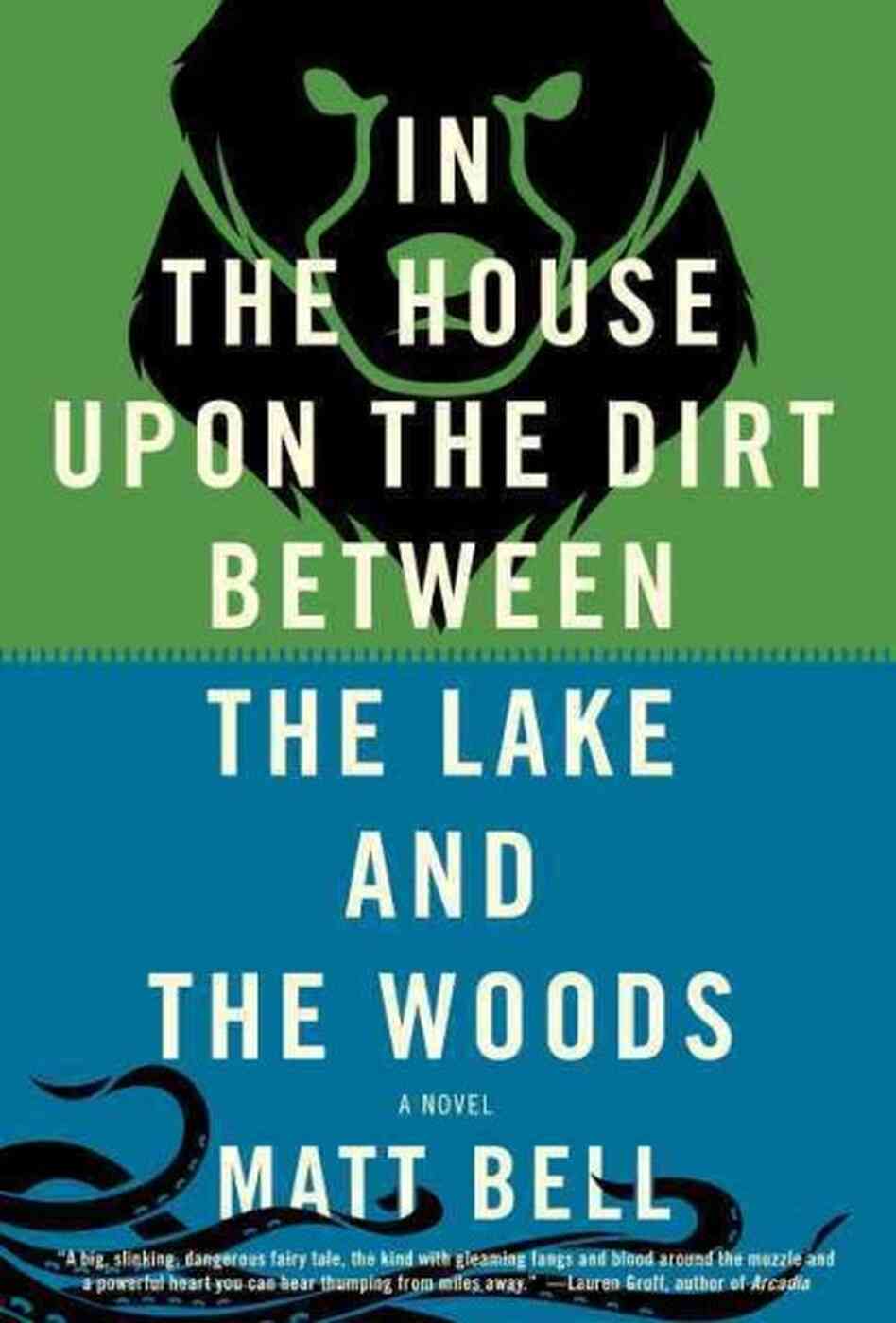
In the House Upon the Dirt Between the Lake and the Woods by Matt Bell


In the House Upon the Dirt Between the Lake and the Woods by Matt Bell


      According to the book blurb, this is a story of what happens when a man and his wife desire a child, but one is not forthcoming. It is supposedly about love and parenthood and loss and dreams.

      A man and wife move to a lakeshore far away from civilization. They make most everything by hand and attempt to build a family. Each attempt is failed and the man actually eats the first stillborn baby in the first chapter. This son continues to exist inside the man and talks with him frequently and tries to take over his body at some points. There is a terrifying, rotting-alive bear in the woods which nightly resurrects the animals the man traps and kills. There is a ghost squid that lives in the lake. It used to be married to the zombie bear and it also gives the man the power to transform into a squid when in the lake. The wife can sing things into existence and pull the stars down from the sky with her voice. She takes the zombie bear’s cub and sings it into a human child, an act that causes friction between the couple. The house also seems alive, producing a seemingly infinite number of rooms that the wife populates, using her songs, with memories, scenes, objects, and emotions.

      I will admit that this book does allow me to use the phrases “zombie bear” and “ghost squid” which are two phrases that I never expected to use in a discussion of a literary fiction novel. This aside, a detailed summation of the plot reads more like some sort of mad-libs exercise that the plot of the novel. Stylistically, Bell does some very unique and interesting things with the story. Had they been located within a short or even a novella, it might have worked or at least been less tiresome. Yet, the frequency that these devices and phrases are used over the course of 300+ pages; one begins to tire of seeing “upon the dirt”.

      Truly in a shorter format, I would find Bell’s style, and possible even this story, to be interesting, unique, and engaging. Despite my reservations, I will look for Bell’s work in the future to see if he is has fully adapted his style to the novel format.

Tuesday, December 10, 2013

A Year in Reading


A Year in Reading

Looking back over the books I have gone through is always an interesting experience, teetering between quite pride and the number of books I have read and despair at the sheer volume of books in my ever expanding to-be-read pile. Anyway, what follows are the highlights (that I have not already reviewed here), not the worst, not the best, but those that stuck in my mind for whatever reason.

 
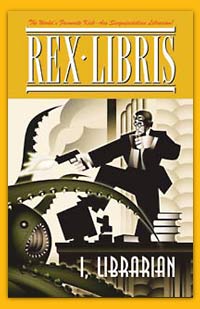
Rex Libris: I Librarian (Volume 1) By James Turner
Rex Libris: Book of Monsters (Volume 2) By James Turner

Ah, Rex Libris, immortal librarian that brave any foe to the farthest reaches to retrieve overdue books. Only the TV mini-series The Librarian, starring Noah Wyle, comes close to the campy feel that Rex brings. However, the sheer volume of oddball fact and trivia and ridiculousness that Rex and hic companions brings cannot be rivaled.


The People of Forever Are Not Afraid by Shani Boianjiu

I picked this up as a book for consideration for a book club figuring that a novel of three young girls in their mandatory military service set in the Middle East would make for some interesting discussion.  However, the book was a slog through muddled apathy. I forced myself to push through to the end, holding out for a redeeming ending only to be disappointed.


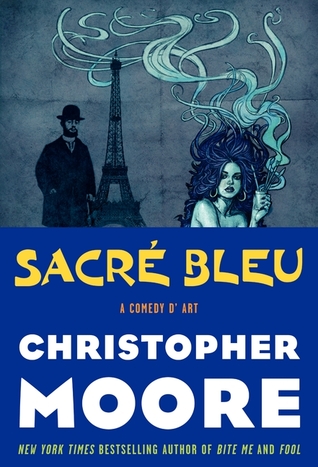
Sacré Bleu by Christopher Moore

This is my 2013 book that I tell people about and all but throw at them. Well written, well researched, excellent layout, beautiful cover design. If you like art or Christopher Moore, or just odd/dark humor, just read this book.


The Emperor’s Soul by Brandon Sanderson

This novella won a Hugo Award and one you finish it, it is easily to understand why. Sanderson creates an amazing world, rich characters, and adds a dash of existential debate, all within 200 pages. He has been getting a good amount of buzz as of late and this might be a good way to ease into his writing, which can be a bit overwhelming in some instances.


The Dinner by Herman Koch

One of two books that, when done, I had the urge to chuck across the room (The other being The Particular Sadness of Lemon Cake). The idea being of a story slowly unfolding and progressing just as the meal that the characters are eating does is very intriguing. It was touted as revealing a dark side of society and making the reader question how far they would go to protect their family. I more felt that it was a rambling and entirely unreliable narrator justifying criminal activity.


Saga (Volume 1 & 2) by Brian K Vaughan

A simply amazing story of a new family risking everything to find their place in a war torn galaxy. With heavy doses of science fiction and fantasy, these graphic novels flawlessly blends love, grit, violence, and of course hope into an award winning series.  I certainly recommend grabbing this one up if it even sounds remotely interesting. You will not regret it.


Tuesday, September 3, 2013

The Facades by Eric Lundgren


The Facades by Eric Lundgren

Lundgren’s debut The Facades follows Sven Norberg through the Midwestern town of Trude, hunting for his missing wife. One night, Molly, Trude’s celebrated mezzo-soprano, disappears after rehearsal one night with no hints as to what happened. Convinced that something sinister was at work, Sven becomes obsessed tracking down his wife. His hunt takes him through many of Trude’s unique buildings and interacting with some very odd characters. There is his son who is drifting away after the disappearance of Molly, a group of rebellious librarians whose leader lusted after Molly, a sunglasses wearing cop known as The Oracle, a music critic that speaks of Molly in acrostics in his articles, and of course the odd architecture of the city. In fact, as the novel progresses, Sven seems to only find peace communing with the mall, the central library, the opera house, and the assisted living home, all constructed by the eccentric architect, Bernhard.

While it may seem like and oddly constructed who-done-it, The Facades is more an existential stroll through a surreal land. Stylistically, Lundgren’s writing is simply compelling. With sentences laden with bizarre and delightful metaphors he works up the reader’s inquisitiveness in both the mystery of Molly and the oddities that makes up the city of Trude.   

To some, the ending may seem unsatisfactory in how Lundgren resolves the major questions brought up in the book. However, I feel that the ending is a perfect match for the tone set by Norberg’s persistent, yet absent-minded approach to his wife’s disappearance. Coming it at a relatively small 272 pages, this book would make an good and interesting weekend’s reading.

Saturday, November 24, 2012

National Book Awards 2012

It's the end of the year. The days have grown shorter, the shopping lines have grown longer, and the time has come to reflect on the literary contributions that have been made in the past year. Last week, the 62nd National Book Awards were announced, marking the best contributions to American literature in the past year and raising awareness and appreciation of great writing.  Each of the winners is available to check out. Let us know what you think of these great American books!

Fiction Winner - The Round House by Louise Erdrich
- In the spring of 1988, 13-year-old Joe's mother was brutally attacked, irrevocably transforming Joe's life. Despite his attempts to heal his mother, she will not leave her bed and slips into an abyss of solitude. Frustrated with the official investigation and his own father's inability to resolve the situation, Joe and his friends attempt to find answers, beginning at the Round House, a sacred space and place of worship for the Ojibwe.

Non-Fiction Winner - Behind the Beautiful Forevers by Katherine Boo
- A poignant examination at the personal level of the schism between the upscale resorts and the slums of India. Boo combined three years of investigative journalism and personal interviews to provide insights that have been widely applauded as the most honest portrayal of India as a culture in transition.

Poetry Winner - Bewilderment : New Poems and Translations by David Ferry
- Praised for his passion and the scope of his poems, Ferry has published a collection of original poetry, translations of classics, and poems responding to poems.

Young People's Literature Winner - Goblin Secrets by William Alexander
- Rownie is the youngest of the stray children living with a witch named Graba. Desperate to find his older brother, an actor who has disappeared after the prohibition of acting, Rownie joins a troupe of traveling goblin actors who are also eager to find his brother in the hope that he might be able to save their town. 

For more information on the National Book Award, including a complete list of nominees in 2012 and previous years' winners, check out http://nationalbook.org/

Saturday, October 20, 2012

The next Thursday Next

I've been in the midst of some fairly heavy books lately...good books, but nothing that has made me laugh. Whether from Geronimo T. Johnson's Hold it 'til it Hurts, a stunning debut about war, family, race, and love, or Andrew Porter's widely-acclaimed debut In Between Days about the disintegration of a family, I needed a break.  What better respite than a book about an impending smiting in the city center, doppelgangers with a 24-hour life span sneaking in and stealing the protagonist's consciousness, dealing with a daughter who's never existed, and a 64% chance that the world will be annihilated in 37 years because time travel has been un-invented?  Oh, and did I mention the dodo bird who spends a lot of time thinking about The Dukes of Hazzard reruns? 

Jasper Fforde has lifted my literary spirits yet again with his seventh book in the Thursday Next series The Woman Who Died a Lot: Now With 50% Added Subplot. Fforde has created a world in which science fiction and literary classics are smooshed together with a level of absurdity that flirts with annoying, but is just smart and funny enough to keep it from crossing that line.  In the latest addition to the series, the famous literary detective Thursday Next is still suffering from her injuries sustained in Book World and is trying to adjust to her new position as the Chief Librarian at the "All-You-Can-Eat-at-Fatso's-Drink-Not-Included Library." At the same time, she continues to battle Goliath Corporation and her nemesis Jack (I don't think I can publish his last name here because even though it's spelled differently, it still sounds and reads the same). Her children play an important role in this book, with Tuesday attempting to create an anti-smote field by week's end and give a keynote speech at the MadScientists' Convention all while trying to be a normal sixteen year old girl, and Friday adjusting to the fact that he's gone from a promising future as the head of the Chrono-Guard to a certainty that he will murder someone by Friday. As for Jenny? Well, she still never existed.  Confused? It's to Fforde's credit that this all manages to tie together and add to the story, rather than detract from the plot with its silliness. 

The Woman Who Died A Lot is a refreshing return to what Fforde does best, after a rather weak turn in the sixth book of the series, One of Our Thursdays is Missing.  If you've never read any of Jasper Fforde's books, I highly recommend starting with The Eyre Affair, in which Thursday Next is introduced and saves all of literature in well fell swoop. 

Tuesday, December 27, 2011

A Delicious Read

In general, I don't recommend a book until I finish it.  I have a lot of very well-read friends and I don't want to stake my reading reputation on an unknown quantity.  And yet, 25 pages into a recent book, I started alerting friends, "Put this on hold!  You must read it."  White Truffles in Winter by N.M. Kelby struck me as a luscious, elegant, warm read about the life of Auguste Escoffier, a renowned French chef from the early 20th century, and his wife, Delphine.  While I was somewhat nervous about having made a recommendation so soon into the book -- equivalent to recommending a meal after the appetizer -- I'm pleased to report that by the dessert and coffee course of the book's end, I was equally as enthusiastic as I had been at the onset. 

Kelby elegantly wove a story that begins as Delphine is dying, bereft of a dish named for her.  She is anxious that the world will not believe that her husband truly loved her unless he names a dish for her.  Her concern is compounded by the number of dishes he created for and named after others, especially the other women in his life (including actress Sarah Bernhardt and opera soprano Nellie Melba -- of the peach and toast fame).  Escoffier resists, insisting that there is no dish that can adequately capture her.  Instead, Escoffier spends his time working on his memoir, which Kelby fleshes out with extended scenes from Escoffier's past. 

Like a good meal, a good book is often difficult to describe to those who have not yet experienced it and, like different flavors, what appeals to one person won't necessarily appeal to another.  So, with that caveat, I highly recommend this to fans of historical fiction, love stories, and foodies.  Bon appetit!

Tuesday, December 13, 2011

A woman who knows how to write

Several months ago, Nobel laureate V.S. Naipaul infamously opined that women authors are inferior.  He argues that women's "sentimentality, the narrow view of the world" leads to them writing "...all this feminine tosh."  Of course, he quickly asserted, he didn't mean any of it unkindly.  When I read the article, I quickly jotted down a list of women authors whose work consistently astonishes me, in part because of its lack of sentimental "tosh."  Writers like Geraldine Brooks, Barbara Kingsolver, Louise Erdrich, Marilynn Robinson, Toni Morrison, Margaret AtwoodKate Chopin (who was excoriated for her lack of sentimentality), and Jamaica Kincaid all jumped to mind.  One who didn't, but ought to have is Anne Enright, Man Booker prize-winner for The Gathering and Irish author extraordinaire.

Enright has published a new book.  The Forgotten Waltz poses, for me, an interesting question: Can you like a book if you don't like the characters?  There isn't anyone in this book who reads as particularly sympathetic.  I found myself reading the book increasingly frustrated by the characters.  Gina, the narrator and protagonist, is a 32-year old married woman who embarks on an affair without much buildup or apparent cause or remorse.  Sean, her married lover and father of a 12-year old daughter who's somewhat cryptically referred to as "not quite right", has clearly done this before.  The supporting cast are not particularly more sympathetic.  I did not feel a connection with any of the characters but despite that, or perhaps even because of it, I was completely engrossed by the book.

While I did not particularly care for the characters, and the plot itself is rather unremarkable, Enright's writing is breathtaking.  There is very little sentimentality, but a great deal of evocative prose.  Simple sentences are used to convey much more.  One of the most striking examples for me came in the days after Gina's mother's death. Gina wanders through her mother's home, noting that the mirror is the cleanest thing in the house because it refuses to hold on to the past.  Enright's writing is crisp and meaningful, and that it was a written by a women doesn't make that particularly noteworthy.  Enright is one of a tradition of great depth and great breadth: excellent women authors. 

Incidentally, for a little fun, check out this quiz that The Guardian put together to see if you can determine whether a passage was written by a man or a woman.  They've dubbed it "The Naipaul Test."  Perhaps it could also be named "The Enright Test."

Tuesday, October 25, 2011

World Cup Caliber Authors from the United States

This week we are celebrating the runners-up of the Women's World Cup by highlighting writers from the United States.  Since there is not enough time or space to cover all of the states, we are choosing the states from where most of the ladies on the team hail:  New Jersey and California.

From suspense and thriller novelists Mary Higgins Clark and Harlan Coben to award-winning children's author Sharon Creech, New Jersey is birthplace and home to many talented writers.

Edna Buchanan--this Paterson, NJ, mystery author and journalist won the 1986 Pulitzer Prize for reporting.

Janet Evanovich--this NY Times best-selling author is most well known for her wacky Stephanie Plum mysteries set in Trenton.

Laura Anne Gilman--this New Jersey born science fiction, supernatural romance, and fantasy novelist was nominated for 2009 Nebula Award.

Belva Plain--this novelist lived in Millburn and died in 2010 at the age of 95. At the time of her death there were over 30 million copies of her books in print.

Philip Roth--this Newark literary novelist has won two National Book Awards, three Pen/Faulkner Awards, and the Pulitzer Prize.


California is full of great writers including science fiction and fantasy greats Kage Baker and Greg Bear and 2-time Nebula Award winner Catherine Asaro. Try one of these other gifted authors from the Golden State.

Nevada Barr--this writer grew up in Johnstonville and writes mysteries starring Anna Pigeon, a female law enforcement ranger for the National Park Service.

James Ellroy--this Los Angeles native wrote gritty crime novels including L. A. Confidential and The Black Dahlia.

Shirley Jackson--this queen of psychological horror was a San Francisco native and wrote the short story "The Lottery" and the novel The Haunting of Hill House.

Maxine Hong Kingston--this Chinese-American writer and professor from Stockton won the National Book Award in 1981 for China Men.

John Steinbeck--born in Salinas, this author penned the Pulitzer Prize winning The Grapes of Wrath, the often filmed East of Eden, the tragic novella Of Mice and Men, and many other classics.  He was awarded the Nobel Prize for Literature in 1962.

Thursday, August 11, 2011

Barbara Kingsolver wins the Distinguished Achievement Award

Barbara Kingsolver has been named the recipient of the 2011 Richard C. Holbrooke Distingushed Achievement Award (formerly named the Dayton Literary Peace Prize Lifetime Achievement Award).  She will be in Dayton on November 13 to accept the award, which will be presented by journalist Kati Marton, Holbrooke's widow.

Barbara Kingsolver has degrees in biology and has been writing since 1985.  The Holbrooke award is only the latest in a series of awards and recognition she has earned for her writing.  She has been named one of the most important authors of the 20th century by Writers Digest.  In 2000, she received the National Humanities Medal, the nation's highest award for service in the arts.  Her book The Poisonwood Bible was a finalist for the Pulitzer Prize, and 2009's The Lacuna was a finalist for the PEN/Faulkner award.  She has been recognized by groups such as the Physicians for Social Responsibility and the American Library Association. 

If you've never read one of Kingsolver's books, you're in for a treat.  Start with Prodigal Summer, The Bean Trees or The Poisonwood BibleOr, if you're more interested in nonfiction, try Animal, Vegetable, Miracle: A Year of Food Life. 

Tuesday, August 9, 2011

Hey, what do you think I should read?

I just finished reading The Borrowerauthor Rebecca Makkai's first novel.  It was, admittedly, a bit self-indulgent because it focuses on a librarian but --  for the record -- that's where the similarities end (the story centers on the time during which librarian Lucy kidnaps/runs away with a 10-year-old patron).  Still, a moment that rang particularly true for me is when Lucy identifies what she calls "the world's best question".  It's, "Hey, what do you think I should read?"

There's something really great about connecting over a book. When I love a book, or when one gets in my head, I often gently and kindly ask my friends to read it so we can talk about it. (And if my friends tell you that it's more along the lines of me shoving the book at them while rudely demanding they read it, well...potato, potahto, right?)  But, as much as I love the connection you can get from a shared book and as much as I like sharing ideas about what to read, I get a little nervous when someone I've never met asks me to recommend a good book to read.  (Given that this is part of my job, that could be a serious problem.)  If I have a chance to talk with that person and find out what she loves and hates, what her favorite book is and what bestseller she thought was over-rated, I can feel pretty good about finding the right book.  But, to pick a book for someone who hasn't got any preferences and is just looking to start reading more, well -- that's some pressure.  It's happened a few times recently, and all I could think was, what if I misjudge what she would like?  What if I pick something he hates?  What if I single-handedly destroy someone's love of reading by suggesting something that I loved but that someone else thinks is a real dud?  What if, just maybe, I'm overreacting a bit?  What if what they're really looking for is just any book that someone -- anyone -- has liked?

In the past few weeks, I've had to read a few books with absolutely no idea what they were about.  It was a surprisingly great experience and I ended up reading some great books I might not otherwise have found.  It got me out of a reading rut, where everything was starting to sound the same.  It can be a way to find new authors or genres to start following.  And, it can be just good fun to stretch your reading choices a little.

So, how about this?  I'll throw out the titles of a few books I've really enjoyed reading lately, with no extra information, and you do the same.  I don't know what you like to read and, unless you read the blog regularly, you probably don't know what I like to read.  So, let's share:

War by Sebastian Junger
Gardens of Water by Alan Drew
Caleb's Crossing by Geraldine Brooks (who continues to impress me as one of the best writers around...sorry, I couldn't help it)
The Good Life by Jay McInerney
Then Came You by Jennifer Weiner
You Wish by Mandy Hubbard
The Little Women Letters by Gabrielle Donnelly
Big Girl Small by Rachel DeWoskin
The First Husband by Laura Dave

Okay, now it's your turn:  "Hey, what do you think I should read?"

Saturday, March 26, 2011

The Adults

The Adults, Alison Espach's debut novel, has left me feeling a bit discombobulated.  It is wryly, tragically humorous and the dialog between characters is so smart, it reads like an Aaron Sorkin or Amy Sherman-Palladino script.  (Nobody I know talks like this in real life, but it's fun to imagine they do.)  Still, the humor is laid like a thin veneer on top of a very troubling story.  It is the story of Emily Marie Vidal, an appropriately disaffected 15-year-old from an appropriately dysfunctional family in a wealthy neighborhood in suburban Connecticut.  It is the story of her father's infidelity with the neighbor, her parents' subsequent divorce, and the apparently-related suicide of the neighbor's husband.  It is the story of the illicit love affair between Emily and her 24-year-old English teacher that grows amidst the tragedy.  And, ultimately, it is the story of growing up, even if what that means is different than what it seemed in childhood to be. 

None of the characters escape Espach's pen in the assessment of the 21st century disaffected, ironic, suburban culture.  Each of the characters, including Emily, is portrayed with flaws.  Each seems to be striving toward something they're not: older or younger; richer or more beautiful; more intelligent or less.  The most disappointing aspect of the book is the disconnect between Emily's teen years and her young adulthood.  College is treated with a few cursory sentences in retrospect from the vantage point of her early twenties. Jumping from (chronological) immaturity to (chronological) adulthood glosses over a key time when the transition that is, or ought to be, made.  Each review of this book that I've seen is a little better than the last, but I'm not sure I came away liking the book, and I definitely didn't have much affinity for the characters.  Still, the story is interesting in its unsettling ways and offers a lot to think and talk about.

Saturday, March 19, 2011

It only takes a moment

  It's funny how one moment or event can make time slow and make you look at your life.  The book written by Lisa Genova, Left Neglected takes a glimpse at life for Sarah and her family.  Sarah was independent and a work-a-holic. She enjoyed her family but making time for them was another item on her long to-do list. This to-do-list came to a crashing halt the day she was looking for her phone while driving. It changed her family's life forever.

Lisa Genova follows up her NY Times best seller, Still Alice, with another surefire hit.  Left Neglected  is another fantastic book that details the lives of those who are brain injured. Her new book focuses on Left Neglect, an unusual brain injury, that is caused by damage to the right cerebral hemisphere. This injury causes the person to visually neglect the left-hand side of space. This means that the person with this injury cannot feel, recognize or see things on their left side. It could be the left side of a room, the left side of their body or even the left side of their plate.

Genova approaches this serious subject with humor and candor. She shows us what it is like as Sarah begins to realize all the changes she needs to make in her life to cope with her disability.  I highly recommend this book and hope you will look at your own priorities.  Perhaps one of the choices you will choose to make is not texting and driving.

Saturday, March 12, 2011

A Little Ffamily Ffun

I've been reading Katie Fforde's books for years.  She writes charming, witty, cozy British chick lit.  Her style is predictable but reliable, and I know there's a good chance I'll enjoy whatever she puts out.  Her latest, Love Letters, certainly fits the bill.  A somewhat shy bookseller gets roped into planning a literary festival in the English countryside.  In order to get financing, she has to convince Ireland's version of J.D. Salinger (only younger and more handsome) to attend.  Predictably, misunderstandings, chaos, romance, and a few large dogs ensue.   Equally  as predictably, I really enjoyed it.  (Of particular note, if this book hadn't been released in the UK in 2009, I would've thought for sure a dinner party scene was taken directly from the Jennifer Weiner and Jodi Picoult v. Jonathan Franzen and the literati brouhaha this past summer). 

Somewhat (by which I mean completely) tangentially, several years ago while browsing the shelves I noticed another author with the last name Fforde, this being Jasper, cousin-in-law to Katie.  I ignored him for years because I thought he wrote straight science fiction and, with all due respect to you sci-fi types, it's not on the top of my reading priorities.  But as I was putting together some book recommendations for a friend who was looking for witty, upbeat, literary fiction (it's a fairly short list) one name kept popping up.  I'll give you a hint: it rhymes with "lord" and is spelled with a few extra letters.  I realized that his books are much more difficult to define, and far more intriguing than I had given credit for.  I've just finished The Eyre Affair, the first of the Thursday Next series.  It's an alternate history in which literature is the most important part of culture, time travel is routine, and the third-most wanted man in the world is kidnapping fictional characters.  Thursday Next is the special ops literary detective assigned to finding Jane Eyre.  He's also got a series on nursery crimes (and, yes, they do include Humpty Dumpty's infamous fall). 

Of course, this is the part where readers everywhere are wondering: what is the connection?  How will she pull these together?  What is the tie that binds?  Well, ffrankly, these two Ffordes' books have nothing in common with each other.  But, really, when I read two books by two Ffordes in the same week, do you expect me to be able to ffight the temptation to sprinkle the blog with a ffew extra "f"s?  Ffat chance. 

Saturday, February 12, 2011

A March madness bracket I have a clue about


image © Jim Trelease 2006
 Growing up a Hoosier, I was a basketball girl.  My first crush was not on a movie star, but on an IU basketball star.  But when I was 11, I moved out of Indiana, and the state kept my interest in basketball in that split.  It's probably been at least 10 years since I've watched an NCAA or NBA game.  When the annual brackets come out, I make my selections based entirely on school name (it makes me very happy that Gonzaga has done so well the last few years).  This year, though, I have found a March madness bracket that is more than a random collection of names to me.  The Morning News' Seventh Annual Tournament of Books pits sixteen great books of 2010 against each other. 


These are not necessarily the books The Morning News deems to be the "best" books of the year; rather, as they wrote, "Each of these books was chosen because it was hyped. Or celebrated. Or not celebrated or hyped enough. Or because it won an award. Or because an individual (or individuals) we admire lobbied passionately for its inclusion."  In addition to bragging rights to rival Duke's, the winner of the bracket will get a rooster (which offers serious contention to the Bollinger Everyman Wodehouse award for the best literary prize involving livestock).  There is also a "Zombie" round, in which the two books that received the highest number of fan votes before the bracket began can be brought back in to the mix, despite having been voted out of the head-to-head competition. 


I've read six of the books in the Sweet 16 of this contest, and several more from the original long list, and I'm very eager to see what makes the cut.  While I'll still be judging basketball teams by their names, I'm feeling pretty good about my chances in The Morning News pool. 

Tuesday, January 25, 2011

A book worth a cup of coffee

If you're a regular reader, you might have caught my cantankerous rant slightly contrarian post a few weeks ago, in which I listed a few of the heralded books of the year that I had no interest in reading.  Miss Betty here at the library noticed and challenged me to overcome my apathy about Tom Rachman's debut novel, The Imperfectionists.  We have often discussed books and have had similar reactions to many books, so Betty's recommendation alone would've had me rethinking my aversion to the book.  But then she took it a step further: she was so sure I would like the book that she bet me a cup of coffee I would like it.  This was serious -- I do not mess around when it comes to coffee, which Betty everyone who's known me for ten minutes knows, so I accepted the caffeine-infused gauntlet that had just been thrown. 

Well, dear reader, I now know what Betty takes in her coffee.  I'll admit: for the first chapter, I thought that I was surely going to be sipping on my brew from atop my high horse.  After a slow start, though, I started to understand the story and before I knew it, I was nearly finished.  The Imperfectionists is about the people who comprise the staff (and one reader) of an English-language newspaper in Italy.  Just as the paper struggles to maintain its relevance in the 24-hour-news-cycle 21st century, each of the individuals profiled is struggling to maintain relevance in his or her own personal life.  Some were more likable than others, but each struggled with this sense of relevancy.  Intertwined between the chapters, Rachman tells the story of the newspaper's creation and its successes and failures over the subsequent years.

The Imperfectionists reads a bit more like a collection of short stories connected by an inky thread.  The book reminds me of the idea that we are all extras in the movie of someone else's life.  The short story feel serves to strengthen, rather than diminish, the book's message of discovering the personalities that lie behind the surface of the extras who surround us.  It's a great book, and I now publicly, gladly, concede it merits the buzz surrounding it.  It also goes great with a cup of coffee.